How I write and publish with Claude, Tamable and Wispr Flow
A five-minute read used to take me days, so I rarely published. This is how I write today, as ideas to borrow rather than a recipe. I talk, Claude interviews me and drafts, and Tamable keeps about two weeks of posts lined up, none of them going out without my OK.

I talk. My AI interviews me. I approve.
I don’t write posts anymore. I talk. When my queue runs short, Claude interviews me about what I’m working on, and I answer out loud, long and messy, while Wispr Flow turns what I say into text. Claude tells me what it found, saves the ideas I say yes to in my own words, and drafts posts from them. Nothing goes out until I read it and press Approve.
Why not just Claude?
Claude is the best interviewer I’ve found. But a chat is a bad place to keep things: ideas get lost in old conversations, drafts end up spread over a dozen threads, and nothing stops a half-finished post from going out. Tamable is the part that stays put.
It’s also one place for everything I publish, wherever it goes. Today that’s X and my blog.
A plan, not a recipe. This is how I try to work. Some weeks it runs exactly like this; plenty of weeks it doesn’t, because plans fail all the time. Take what’s here as ideas: keep what fits, change the rest and make the system your own. Mine keeps changing too; what changed is at the bottom.
What I talk about, and why
I write in public so people get to know me: a developer with a day job, a kid and a few products, figuring it out as I go. Real conversations are the goal. Followers, signups and readers come as a side effect.
All of it lives in one place: my writing strategy in Tamable, one plain-text field under Settings, Writing strategy. It’s written to Claude, and Claude reads it before every interview and every draft. Mine started from Claude’s questions and grows a line at a time, whenever a draft sounds off. A few lines from it, to show the idea rather than to copy:
Only write what actually happened to me. Never invent anecdotes, numbers, names, quotes, feelings or experiences. If a post needs a story I haven’t told you, ask me for the real one instead of filling the gap.
Warm and conversational, like talking to a friend who builds things too. Explain the “why” behind a decision, not just the “what”.
No clickbait or engagement bait: no hook-line formulas, no “Here’s what I learned” templates.
Keep about two weeks of posts dated ahead. When the queue gets shorter than that, it’s time for an interview round.
Four pillars
The broad themes I write about. Ideas and posts sit under one, and Tamable marks a pillar as quiet when nothing from it has gone out in a while, which is what Saturdays are for.
- 01Building products
MustLoop, Tamable and sparkling-ui: decisions, numbers, users, wins and failures.
- 02The craft
Being a developer and builder: Laravel, Vue, MCP, building with AI, mentoring, Coimbra.js.
- 03Life
Being a dad and fitting a full-time job, family and side projects into one week.
- 04The world
My take on tech, AI, the job market, and being a person in all of it.
How often
The plan is three posts a week on X, at the same times, so there’s never a decision to make. Some weeks I hit it, some weeks I don’t. A long post is my default; a short post for a single moment; a thread only when the idea really needs steps.
Two journals
Building MustLoop and Building Tamable are series in Tamable: what happened, what I learned, how I feel about it. Tamable adds the number, so Claude never writes it. A public “#3” promises a “#4”, which keeps me going.
How X and the blog work together
The rule I aim for: they never say the same thing twice.
You’ll write yours with Claude in Setup, step 3. Nobody writes this from a blank page.
Three tools, one address
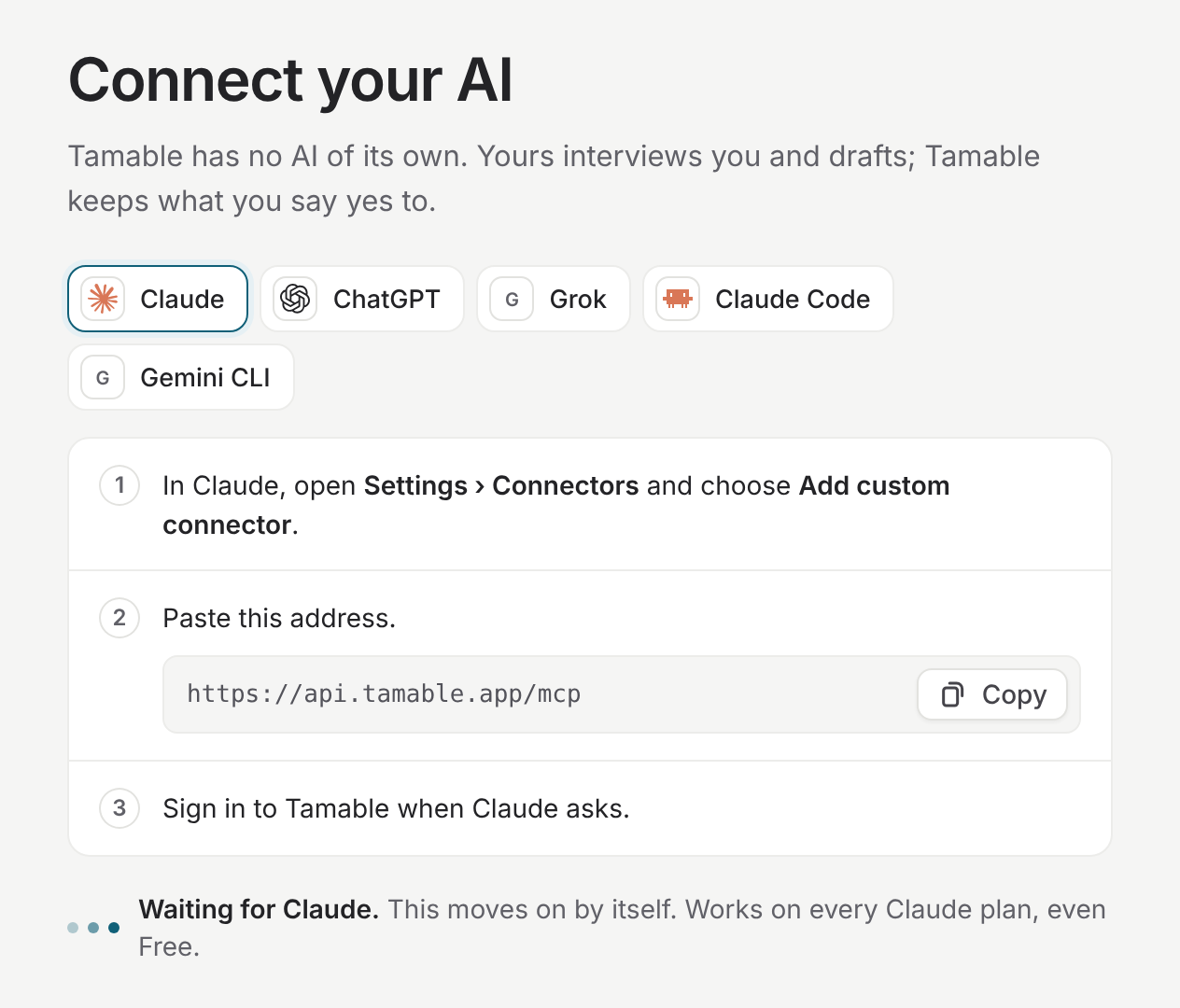
Each tool does one job. None of them needs to know about the others, except Claude, which reaches Tamable through one address. And any of them can change: ChatGPT, Grok, Claude Code and Gemini CLI connect to Tamable the same way, and any dictation app works.
Connect Claude to Tamable
Copy your address from Tamable’s onboarding and add it in Claude as a custom connector. It takes a minute and you do it once.
Install Wispr Flow
I hold the fn key, talk, let go. Any dictation app works; this is the one that keeps up with how fast I ramble.
Write your strategy with Claude
Your writing strategy tells Claude why you write, how you sound, what you post about and how often. You don’t need to know what goes in one: Claude asks the questions, writes it from your answers and saves it to Tamable once you agree, with your pillars. You’ll find it under Settings, Strategy, and you can edit it any time.
This is what I did. I gave Claude everything I’d ever written online: my personal blog, the Ripplr blog and my X archive. It read all of it and came back with how I write, with my own sentences as proof. It described how I write better than I could have. Then it asked about the rest.
Help me write my writing strategy in Tamable, starting from what I’ve already written: [paste a few posts, or attach your X archive].

Start with get_workspace. Read all of my writing, then tell me how I write: how I sound, the topics I keep coming back to, and the habits worth keeping or dropping, with my own sentences as proof.

Then interview me, one question at a time: why I write in public, who for, where I publish and how often I can post, and anything that’s off limits.

Write my strategy from all of that, in my words, as plain text you’ll follow before every interview and draft, and show it to me. Save it in Tamable once I agree, then suggest a pillar for each theme and create the ones I accept.
I reread mine when a draft sounds off, and add a line. “No em-dashes, anywhere” is in there because of one draft.
One real session, last Tuesday
Twenty minutes, on a walk. Here’s one question from it, with my answer exactly as I said it. It’s long and it wanders. That’s the point: the good line is in there, and I didn’t have to find it.
Claude saves the parts worth keeping as ideas in Tamable, word for word. From that answer it kept two: “People don’t quit on bad words; they quit on questions they can’t answer yet,” and the bit about my friend.
Drafts wait for me in Today
In the same round, Claude drafts the posts I said yes to. They land in Today, and that’s where I read them, later, as if a stranger wrote them.
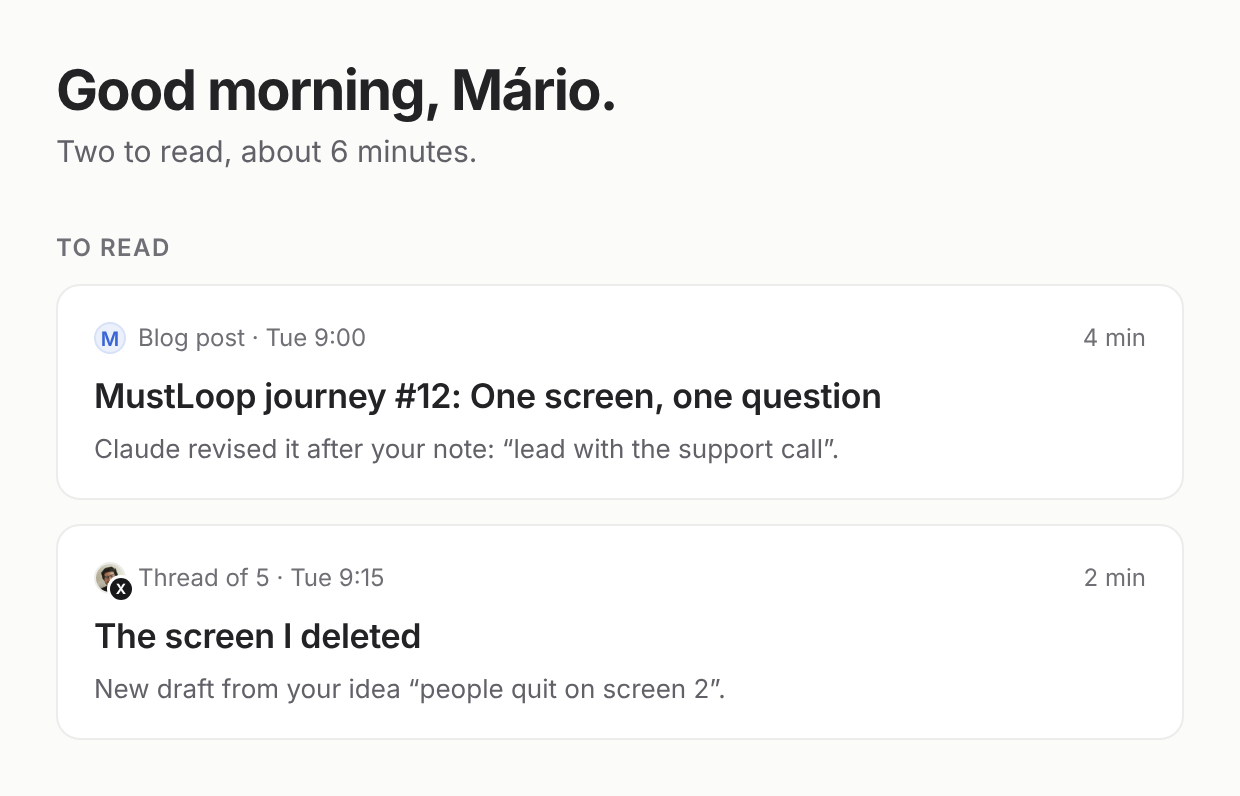
If it’s right, I approve it and it goes out at the time on the card, or I pick another.
If it’s close, I usually fix it myself, right there in Tamable: cut a line, swap a word, move a paragraph.
When it needs more than that, a note does the work. I select the words that are off, say what I want, something like “Shorter, and start with the line about my friend,” and send it back. Claude sees exactly which words I meant and revises it from the same material, at the start of my next session or as soon as I paste the notes prompt, and it comes back to Today.
Notes work for posts I start myself too: I write what I have, and a note asks Claude to draft the rest or finish it.
A small habit, not willpower
Missing a day is fine. Disappearing for a month is not. So the habit is small and tied to things I already do.
On a bad day, three thoughtful replies still count. I try not to miss twice in a row, and the two weeks of posts dated ahead mean a week with a sick kid or a deadline doesn’t break the rhythm.
When I’m stuck, I lower the bar: a three-line honest post beats a perfect one that never ships. Or I paste the stuck prompt and let Claude ask about my quietest pillar, or the last thing that annoyed me at work. There’s always something.
The prompts I actually use
They work as they are in Claude or any other assistant connected to Tamable, but they’re written for how I work. Start from them, then change them until they fit yours.
Interview me for Tamable. Keep it a conversation that never runs dry.

Start with get_workspace and my recent ideas. If I’ve left notes on posts, answer those first. If my strategy is empty, interview me for it first and save it once I agree.

Each round:
- Ask me one to three short questions, then let me talk. I’ll often answer by voice, so my answers may be long and messy.
- Pull the interesting perspectives out of my answers and sort them: threads worth more questions, ideas worth capturing, and posts you could already draft (X posts, threads, blog posts, series parts).
- Ask me what to do with them. Only when I say yes, capture the ideas in my exact words or draft the posts in Tamable.
- Start the next round from the threads I picked. When they run dry, change angle: a quiet pillar, an open idea, a mistake, an opinion, this week’s work.

Never end the conversation yourself. When I stop, list the open threads for next time.
Help me write my writing strategy in Tamable, starting from what I’ve already written: [paste a few posts, or attach your X archive].

Start with get_workspace. Read all of my writing, then tell me how I write: how I sound, the topics I keep coming back to, and the habits worth keeping or dropping, with my own sentences as proof.

Then interview me, one question at a time: why I write in public, who for, where I publish and how often I can post, and anything that’s off limits.

Write my strategy from all of that, in my words, as plain text you’ll follow before every interview and draft, and show it to me. Save it in Tamable once I agree, then suggest a pillar for each theme and create the ones I accept.
Help me write my writing strategy in Tamable. I haven’t really written in public before.

Start with get_workspace. Then interview me, one question at a time: why I want to write in public, who for, what I want to talk about, where I’ll publish and how often I can post, and anything that’s off limits.

Then help me find how I sound: take one of my answers, write it two short ways and ask which sounds more like me, and why. Do it a few times, changing one thing each time: short or long sentences, plain or playful, personal or neutral.

Write my strategy from my answers, in my words, as plain text you’ll follow before every interview and draft, and show it to me. Save it in Tamable once I agree, then suggest a pillar for each theme and create the ones I accept.
Start with get_workspace and my open ideas in Tamable. Tell me which posts they could become, and draft only the ones I pick.

Build each draft from my own words: cut, reorder and tighten, but add nothing I didn’t say. If a post needs something I haven’t told you, ask me. Submit the drafts for review when they’re ready.
Start with get_workspace and list my posts with open notes: the drafts I sent back and the posts I asked you to draft or finish.

For each one, read the note and change only what it asks, starting with the words it points at. Keep the rest as it is, and add nothing I didn’t say. Then answer the note, saying what you changed.
I’m stuck and don’t know what to talk about. Start with get_workspace, pick my quietest pillar and ask me one small, concrete question about it.

If nothing comes, ask about the last thing that annoyed me at work, then the last thing I changed my mind about. One question at a time, and carry on like an interview round from whatever I answer.
What changed
I update this page when my workflow changes, not on a schedule. Sections that changed in the latest update are marked, so you can skip straight to them.